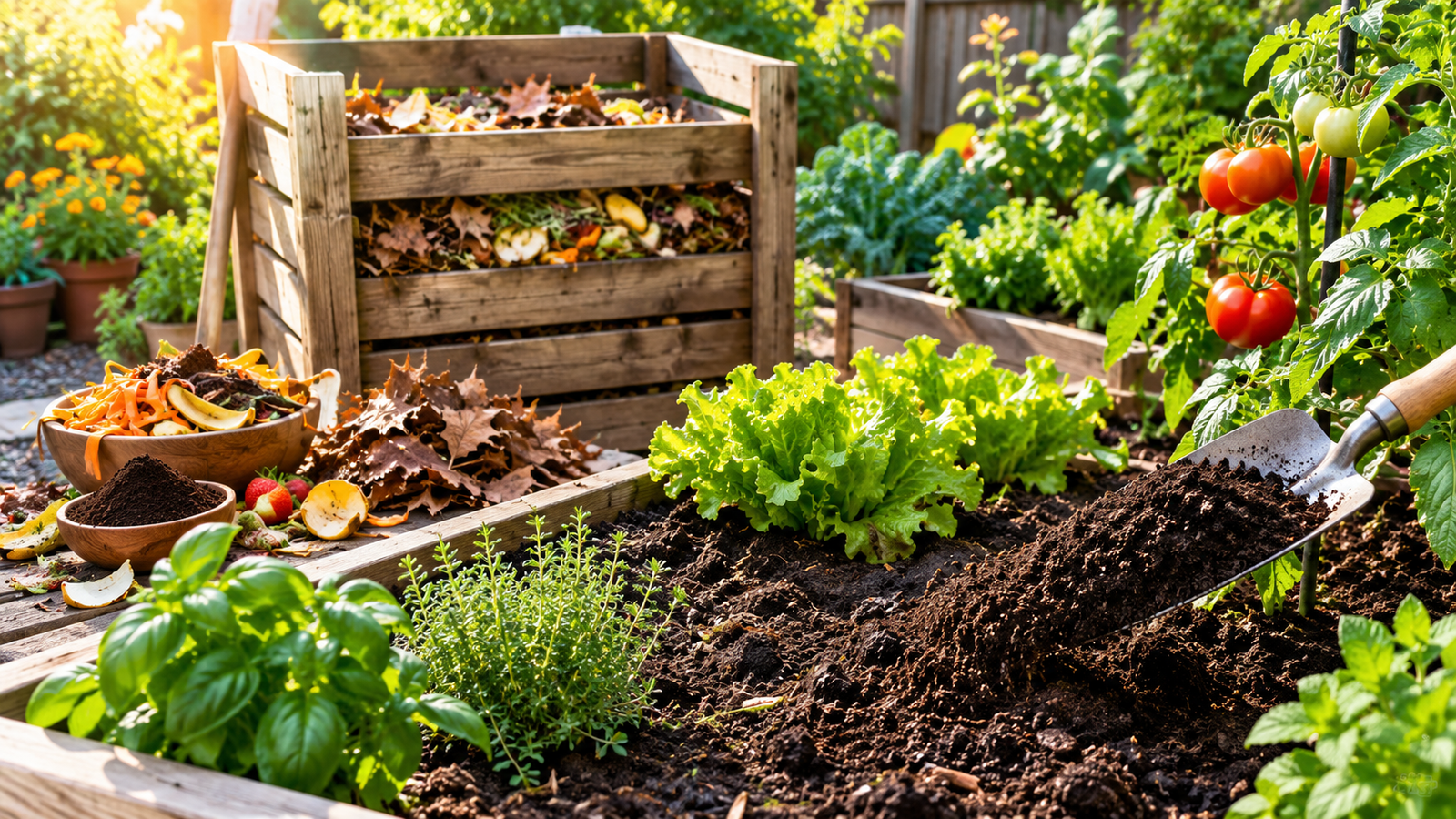
How to Use Compost and Organic Waste in Your Home Garden
Composting is one of the simplest ways to turn everyday organic waste into something valuable for your garden. Instead of throwing vegetable scraps, fruit peels, dry leaves, grass clippings, and other suitable organic materials into the trash, you can recycle them into compost and return those nutrients and organic matter to the soil.
For home gardeners, compost is more than homemade fertilizer. It is primarily a soil amendment that can improve soil structure, water-holding capacity, and biological activity. Finished compost can be incorporated into garden soil, used around established plants, or included appropriately in some growing mixes.
The good news is that you don’t need expensive equipment or a large backyard to begin. A simple compost bin, suitable organic materials, moisture, oxygen, and a little patience can be enough to get started.
What Is Compost?
Compost is organic material that has been broken down by microorganisms under managed conditions. During the process, bacteria, fungi, insects, and other organisms transform plant-based materials into a dark, crumbly material with an earthy smell.
The process is aerobic, meaning microorganisms need oxygen. Successful composting depends on a balance of carbon-rich materials, nitrogen-rich materials, moisture, oxygen, and appropriate particle size.
The finished product should look and smell very different from the materials you originally put into the pile. Instead of recognizable food scraps and leaves, mature compost is generally dark and crumbly with an earthy odor.
Compost should not be confused with partially decomposed food waste. Raw or unstable organic material can continue decomposing after it is added to soil and may cause problems for plants. The goal is to allow the composting process to progress until the material is sufficiently stable for its intended use.
Why Should You Compost at Home?
Home composting provides benefits both for your garden and for waste reduction.
1. It Recycles Organic Waste
A significant amount of household waste consists of food scraps and yard materials that can potentially be composted. Instead of sending suitable organic material to the landfill, you can recycle it into a useful soil amendment.
2. It Improves Soil
Adding compost can improve the physical condition of soil. It can help soil accept and store water and increase organic matter. Compost also provides food for soil organisms, which contribute to decomposition and nutrient cycling.
3. It Supports Soil Life
Healthy soil contains a community of microorganisms and other organisms. Compost supplies organic material that supports this biological activity.
4. It Can Reduce Dependence on Some Fertilizers
Compost contains nutrients, but it should not automatically be treated as a complete fertilizer. Its nutrient concentration is relatively low compared with concentrated chemical fertilizers, and plants may still require additional nutrients depending on the soil and crop.
5. It Reduces Household Waste
Composting allows suitable kitchen and garden waste to become a useful resource rather than simply becoming trash.
The Basic Ingredients of Good Compost
A successful compost pile needs the right combination of materials.
The easiest way to understand compost ingredients is through browns and greens.
Browns: Carbon-Rich Materials
Brown materials generally provide carbon.
Examples include:
- Dry leaves
- Small twigs
- Shredded cardboard
- Plain paper
- Untreated wood chips
- Sawdust
- Straw
- Dry plant material
Carbon-rich materials provide structure and help create air spaces within the pile.
Greens: Nitrogen-Rich Materials
Green materials generally provide nitrogen.
Examples include:
- Fruit scraps
- Vegetable scraps
- Fresh grass clippings
- Coffee grounds
- Fresh plant trimmings
- Young green weeds without mature seeds
Nitrogen-rich materials help microorganisms grow and reproduce.
Water
Microorganisms need moisture to remain active. A compost pile that becomes extremely dry may decompose slowly, while an excessively wet pile can develop poor airflow and unpleasant odors. EPA guidance emphasizes that moisture and oxygen are essential parts of the composting process.
Oxygen
Composting organisms need oxygen. If a pile becomes compacted and air cannot move through it, decomposition can become slower and unpleasant odors can develop.
This is why turning or mixing the pile can be useful.
How Much Browns and Greens Should You Use?
There is no need to measure every kitchen scrap with a scale.
A practical starting point is approximately three parts brown materials to one part green materials by volume. EPA guidance identifies this as a useful general ratio for composting.
However, don’t become obsessed with exact numbers.
If your compost contains lots of wet food scraps, add more dry leaves, shredded cardboard, or other appropriate brown material.
If the pile contains mostly dry leaves and isn’t breaking down, adding more nitrogen-rich green material and moisture may help.
The important thing is to maintain a reasonable balance rather than creating a pile dominated by one type of material.
What Can You Put in a Home Compost Bin?
Many common household and garden materials can be composted.
Kitchen Materials
Suitable materials commonly include:
- Vegetable scraps
- Fruit scraps
- Fruit peels
- Coffee grounds
- Coffee filters
- Tea materials
- Crushed eggshells
Garden Materials
You can also use:
- Fallen leaves
- Grass clippings
- Small plant trimmings
- Old plants after harvesting
- Small pieces of untreated plant material
- Straw
- Small twigs
Other Carbon Materials
Useful brown materials can include:
- Shredded cardboard
- Plain paper
- Untreated wood chips
- Small amounts of sawdust
EPA guidance lists many of these materials among suitable compost inputs, while also noting that some materials are better handled by commercial composting systems rather than a typical backyard pile.
What Should You NOT Put in a Backyard Compost Pile?
One of the most important parts of successful composting is knowing what to leave out.
For a typical home compost pile, avoid adding:
- Meat
- Fish
- Bones
- Dairy products
- Grease
- Cooking oil
- Large amounts of fatty food
- Pet waste
- Diseased plant material unless you have a properly managed high-temperature system
- Materials contaminated with chemicals
- Plastics
- Metal
- Glass
- Synthetic materials
EPA notes that backyard piles generally may not reach temperatures high enough to fully decompose certain materials that commercial composting facilities can handle.
Local composting rules can also differ, so if you’re using a community or municipal composting program, check its accepted-material list.
How to Start a Compost Bin at Home
Starting a compost pile doesn’t need to be complicated.
Step 1: Choose a Location
Choose a convenient area with good drainage. It should be somewhere you can easily access throughout the year and preferably near a water source.
The area doesn’t have to be in full sunlight. EPA notes that a backyard compost pile can work in sun or shade.
Step 2: Choose a Compost Bin
You can use:
- A commercially manufactured compost bin
- A simple wooden enclosure
- Wire fencing
- A basic open pile where appropriate
The important thing is that the system allows airflow and provides enough space for organic materials to decompose.
Step 3: Add Brown Materials
Begin with a layer of dry leaves, small twigs, shredded cardboard, or another suitable carbon-rich material.
Step 4: Add Green Materials
Add vegetable scraps, fruit scraps, grass clippings, or other nitrogen-rich materials.
Step 5: Add Moisture
If the materials are very dry, add some water. Don’t soak the pile.
Step 6: Mix the Materials
Mixing helps distribute moisture and oxygen throughout the pile.
Step 7: Continue Adding Materials
Whenever you add a large amount of kitchen scraps, cover them with brown material.
This helps balance the pile and can reduce odors and pest problems.
How to Keep Your Compost From Smelling Bad
A properly managed compost pile should have an earthy smell rather than a strong rotten odor.
Bad smells usually indicate that something about the pile needs attention.
Problem: The Compost Smells Rotten
The pile may be too wet or lacking oxygen.
Solution: Add dry brown material and turn the pile to improve airflow.
Problem: The Compost Is Very Dry
Microorganisms need moisture.
Solution: Add a small amount of water and mix the pile.
Problem: The Pile Is Wet and Compact
Excess moisture can reduce air movement.
Solution: Add dry leaves, shredded cardboard, or other dry carbon-rich material and mix it thoroughly.
Problem: The Compost Isn’t Breaking Down
Possible causes include insufficient moisture, too much carbon-rich material, poor airflow, or a pile that is too small.
Check the balance of browns and greens and make sure the material is moist and adequately aerated. EPA troubleshooting guidance similarly recommends adding dry material and turning a pile when odors indicate poor aeration or excess moisture.
Should You Turn Your Compost?
Turning isn’t necessarily complicated, but it can help redistribute oxygen, moisture, and materials.
Use a garden fork or shovel to mix the pile periodically.
When turning, move material from the outside toward the center and break up large compacted areas.
You don’t have to turn the pile every day. A compost system can be designed around how much time and effort you want to invest.
If you want a lower-maintenance approach, you can allow the pile to decompose more slowly. If you want faster decomposition, managing moisture, oxygen, material size, and the balance of browns and greens becomes more important.
Should You Chop Your Compost Materials?
Yes, when practical.
Smaller pieces generally provide more surface area for microorganisms to work on. Chopping or shredding larger materials can therefore help them decompose more efficiently. EPA explains that reducing particle size increases the surface area available to microorganisms.
For example:
Instead of putting a whole large vegetable into the compost bin, cut it into smaller pieces.
Instead of adding a large cardboard box, tear or shred it first.
Instead of adding large branches, chip or cut them into smaller pieces.
Don’t feel that everything needs to be perfectly chopped. The goal is simply to avoid adding unnecessarily large pieces when you can easily reduce them.
How Long Does Compost Take to Make?
There isn’t one universal composting timeline.
The speed depends on:
- Temperature
- Moisture
- Oxygen
- Material size
- Carbon-to-nitrogen balance
- Size of the pile
- How often the pile is managed
- Type of composting system
A carefully managed active pile can decompose relatively quickly, while a low-maintenance pile can take considerably longer.
The best approach is to judge the compost by its condition rather than by a specific number of days.
How to Know When Compost Is Ready
Finished compost should look substantially different from the original materials.
Look for these signs:
- Dark brown to dark-colored material
- Crumbly texture
- Earthy smell
- Few recognizable food scraps
- No strong rotten odor
- Original materials are mostly decomposed
There may still be a few pieces of woody material. These can be screened out and returned to the compost pile. EPA guidance describes finished compost as dark and rich or crumbly, with larger undecomposed pieces potentially returned to the pile.
Don’t rush to use compost simply because it has changed color. Partially decomposed material may continue breaking down after being added to soil.
How to Use Compost in a Vegetable Garden
One of the best uses for finished compost is improving garden soil.
Before planting, spread an appropriate amount over the garden bed and incorporate it into the upper soil layer if appropriate for your gardening system.
Compost can improve the soil’s ability to accept and retain water while adding organic matter and supporting soil organisms.
You can also use a smaller amount around established plants as a surface amendment.
Avoid assuming that more compost is always better. Oregon State University Extension specifically warns that excessive compost applications can create problems, including potential impacts on water quality.
Using Compost Around Trees and Shrubs
Compost can also be useful around established trees and shrubs.
Apply it as a surface layer over the soil around the root zone rather than piling it directly against the trunk.
Trees and shrubs have extensive root systems, and the goal is to improve the surrounding soil environment rather than bury the base of the plant.
Compost can be combined with an appropriate mulch layer to help maintain soil conditions.
Using Compost in Raised Beds
Raised beds can benefit from organic matter because the soil is often intensively used for vegetable production.
Before filling or refreshing a raised bed, consider the existing soil, drainage, and the amount of compost needed.
Mix compost with appropriate soil rather than filling the entire bed with pure compost. Compost is a soil amendment, not necessarily a complete growing medium for every situation.
A good raised-bed strategy is to maintain soil structure over time by periodically adding suitable organic matter rather than continually replacing the entire growing medium.
Can Compost Be Used for Container Plants?
Compost can be incorporated into some potting or container mixes, but don’t assume that pure compost is suitable for every container plant.
Containers have different drainage requirements than garden beds. A growing medium that holds too much water can cause root problems.
Use a well-designed container mix and incorporate compost in an appropriate proportion for the plants and growing system.
For houseplants and containers, commercial growing media may be preferable when consistent drainage and texture are important.
Compost Tea: Is It Necessary?
Compost tea is often promoted online as a natural plant treatment, but home gardeners don’t need compost tea to benefit from compost.
For most gardens, the simplest and most reliable approach is to use mature compost directly as a soil amendment.
Rather than spending time trying to create complicated homemade liquid products, focus on producing stable compost and improving the soil.
Good compost, appropriate watering, sunlight, proper plant spacing, and good garden hygiene will generally have a much larger impact on garden performance.
Composting in a Small Apartment or Balcony Garden
You don’t need a large yard to recycle organic waste.
Small-space gardeners can consider:
- Worm composting
- Compact compost bins
- Community composting
- Municipal organic-waste collection where available
Vermicomposting uses worms to help process suitable organic materials and can be particularly useful where outdoor space is limited. EPA recognizes vermicomposting as a home-scale composting option.
If you live in an apartment, check whether your local community or municipal program accepts food scraps. Local programs may have different rules from backyard composting.
How to Store Kitchen Scraps Before Composting
You don’t need to carry every food scrap outside immediately.
Keep a small covered container in the kitchen for suitable organic waste.
To reduce smells:
- Empty the container regularly.
- Avoid letting scraps sit for long periods.
- Keep the container clean.
- Store scraps in a refrigerator or freezer if necessary.
- Cover fresh food scraps with dry brown material once they’re added to the outdoor pile.
EPA recommends collecting food scraps in a closed container and keeping a supply of brown materials such as leaves and twigs available for mixing.
How to Prevent Flies and Other Pests
A compost pile can attract pests when it is poorly managed.
One simple strategy is to avoid leaving fresh food scraps exposed on the surface.
Whenever you add fruit or vegetable scraps, cover them with a layer of brown material such as dry leaves or shredded cardboard.
Maintain an appropriate balance of materials and avoid adding meat, dairy, grease, or oily foods to a typical backyard pile.
A properly managed compost system should not have a persistent foul odor or become an uncontrolled source of pests.
Composting Grass Clippings
Fresh grass clippings contain significant moisture and nitrogen.
If you add a large amount of fresh grass at once, the material can become compacted and restrict airflow.
Instead, mix grass clippings with dry leaves or other brown materials.
This creates a more balanced mixture and reduces the likelihood of the grass forming a dense, wet layer.
You can also leave suitable grass clippings on the lawn after mowing when appropriate, allowing them to return nutrients directly to the lawn.
Composting Fallen Leaves
Fallen leaves are one of the easiest brown materials to collect.
Instead of throwing them away, gather them and use them as a carbon-rich component of your compost.
Shredding leaves before composting can help them break down more quickly.
You can also maintain a separate leaf-composting area if you produce large quantities of leaves.
Having a stored supply of dry leaves is especially useful because they can be added whenever your compost pile contains too many wet kitchen scraps.
A Simple Composting Routine for Busy Gardeners
You don’t need to spend hours managing compost.
Try this simple routine:
Every day
Collect suitable kitchen scraps.
Every few days
Empty the kitchen container into the compost bin if needed.
Whenever you add food scraps
Cover them with dry brown material.
Every week or two
Check moisture and airflow.
When necessary
Turn or mix the pile.
Every few weeks
Check whether the pile is becoming too wet, too dry, compacted, or unbalanced.
This routine is simple enough for beginners and can be adjusted according to the size and type of composting system.
Common Composting Mistakes to Avoid
1. Adding Too Much Food Waste
Large quantities of wet food waste can make a pile overly wet.
Better approach: Add brown material along with kitchen scraps.
2. Forgetting About Oxygen
A compacted pile can develop unpleasant odors.
Better approach: Mix or turn the material periodically.
3. Adding Too Much Water
Compost needs moisture, but it shouldn’t be saturated.
Better approach: Aim for evenly moist material.
4. Using Only Dry Leaves
A pile made mostly of dry leaves may decompose slowly.
Better approach: Add appropriate nitrogen-rich materials.
5. Using Only Kitchen Scraps
Food scraps alone can become wet and unpleasant.
Better approach: Balance them with carbon-rich browns.
6. Adding Problematic Materials
Meat, dairy, grease, and certain other materials can cause problems in simple backyard systems.
Better approach: Follow a clear list of accepted materials.
7. Using Unfinished Compost
Partially decomposed material isn’t the same as mature compost.
Better approach: Wait until the material is stable, dark, crumbly, and earthy-smelling.
8. Adding Too Much Compost to Soil
More isn’t automatically better.
Better approach: Use compost as a soil amendment at an appropriate rate.
Compost vs. Fertilizer: What’s the Difference?
This is an important distinction for gardeners.
Compost primarily improves the physical and biological condition of soil. It adds organic matter and provides a habitat and food source for soil organisms.
Fertilizer is designed to provide nutrients to plants in more concentrated forms.
Compost does contain nutrients, but its fertilizer value is generally low compared with concentrated fertilizers. Depending on your crop and soil test results, plants may still require additional nutrients.
The best gardening strategy isn’t necessarily choosing one or the other. It is understanding what your soil and plants actually need.
How Compost Helps Water Management
Good soil structure is especially valuable when water is limited.
Adding compost can improve the soil’s ability to accept and store water.
This doesn’t mean compost eliminates the need for irrigation. Plants still need appropriate watering, especially during hot and dry periods.
But improving soil organic matter can contribute to a healthier soil environment and better water management.
Combining compost with mulch can be particularly useful because compost improves the soil while mulch protects the surface from rapid moisture loss.
A Simple Home Compost Recipe
If you’re unsure where to start, try this basic combination:
Brown materials:
- Dry leaves
- Shredded cardboard
- Small twigs
Green materials:
- Vegetable scraps
- Fruit scraps
- Coffee grounds
- Fresh plant material
Then add:
- Enough water to keep the pile appropriately moist
- Oxygen through good structure and occasional turning
Mix the ingredients rather than creating thick layers of a single material.
As the pile decomposes, continue adding a mixture of browns and greens.
Final Thoughts: Turn Waste Into a Garden Resource
Composting is one of the most practical ways to connect your kitchen, yard, and garden into a simple recycling system.
Vegetable scraps don’t have to become garbage. Fallen leaves don’t have to be thrown away. Grass clippings and other suitable plant materials can become part of a process that eventually produces useful compost.
The key is balance.
Use a mixture of carbon-rich browns and nitrogen-rich greens. Maintain appropriate moisture. Give the pile enough oxygen. Reduce large materials when practical. Keep problematic materials out of a basic backyard system. And most importantly, give the compost enough time to mature.
Once finished, use compost as a soil amendment, not as a magical replacement for everything your garden needs. Incorporate an appropriate amount into garden beds, use it around established plants, and combine it with good watering, mulching, sunlight, and plant-care practices.
A successful garden isn’t built only with seeds and fertilizer. It starts with healthy soil.
And with composting, some of the resources needed to build that soil may already be sitting in your kitchen and backyard.
